



You already agree on more than you think
Start by separating the facts from how you feel about them. Write down what’s actually true about the property — the size, the distance, the state of the roof — and you’ll usually find you agree on all of it. The argument lives in the next step: which of those facts matters most. Once you can both see that the disagreement is about priorities rather than reality, it stops feeling as though one of you is being unreasonable.

Score it separately, then compare
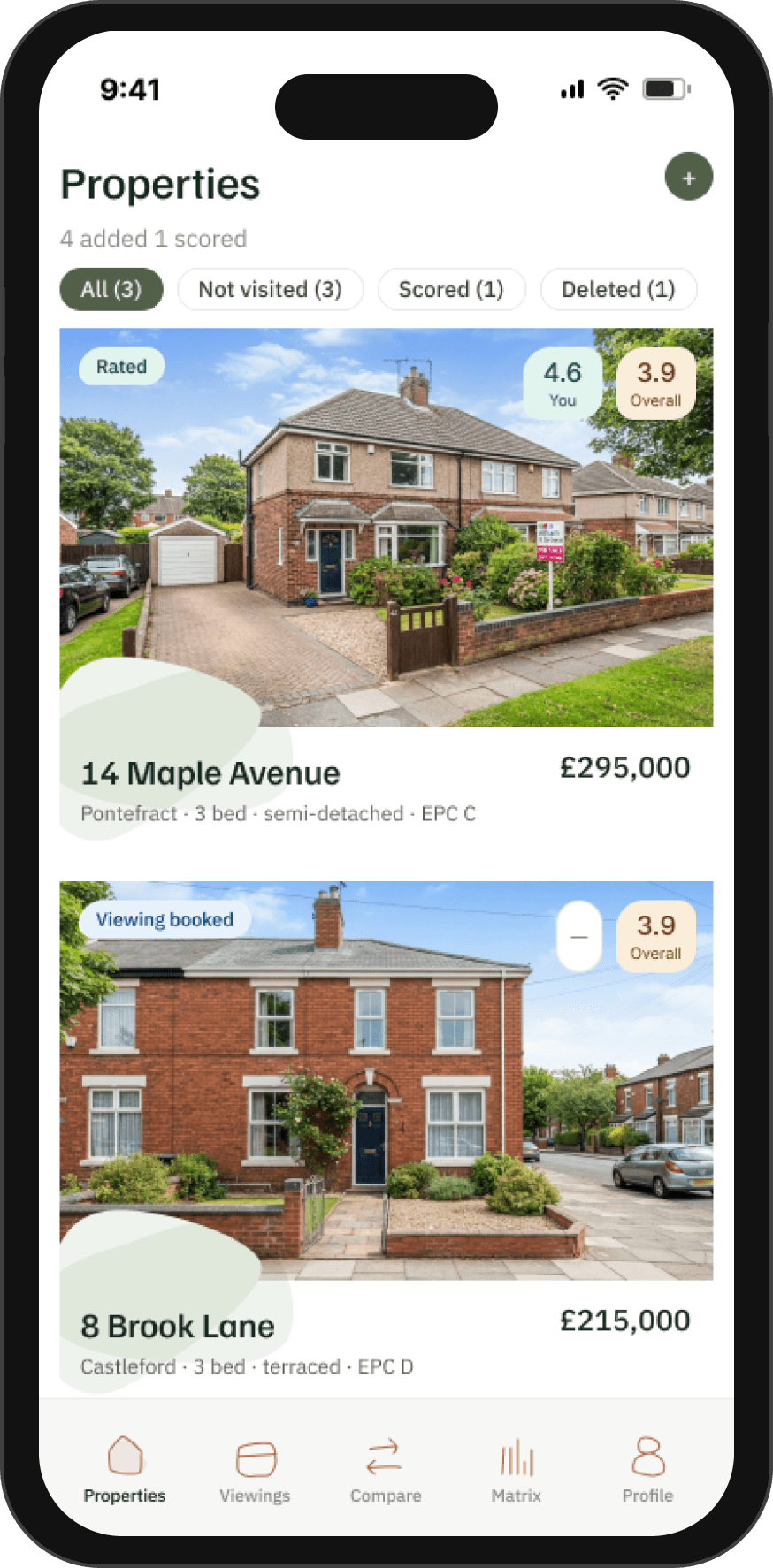
The quickest way to bury a real difference is to talk first. Whoever is more certain — or simply louder — sets the anchor, and the other quietly adjusts to it. You end up with a shared view that was never really shared. Rate the property on your own instead: each of you, against the things that matter to you, before you compare notes. The gap between your two scores is the actual conversation. Sometimes it’s narrower than the row suggested. Sometimes it’s a genuine fork — and now you can see exactly where it sits.
Sort the fixable from the permanent
Not every compromise costs the same. A dated kitchen, a bad colour, a wall in the wrong place are projects — irritating, but reversible. A long commute, a north-facing garden, a busy road, a flood zone are not: they come with the postcode. When you’re weighing one thing against another, give more weight to what you can’t change. It’s easy to fall out over a bathroom you’d replace within a year, and just as easy to under-weight the thing you’ll live with every single day.
- Fixable, in time: kitchens, bathrooms, décor, most layout tweaks
- Fixed, for good: location, aspect, noise, flood risk, the neighbours
Agree the tie-breaker before you fall in love
The worst moment to decide how you’ll settle a close call is while you’re standing in a house one of you has already fallen for. Have that conversation early, in the abstract. Whose priority wins if everything else is equal? Do you each get a hard veto — one thing that rules a property out however good the rest is? Settling the rule before the property means you’re negotiating with each other, not against a house that already has its hooks in.
The aim was never for one of you to win. It’s a decision you can both still stand behind in a year — which is a different, and better, thing than one person talking the other round.
Toflit lets you each score a property on your own, then shows you where you actually differ — so you start from the real gap, not the argument.